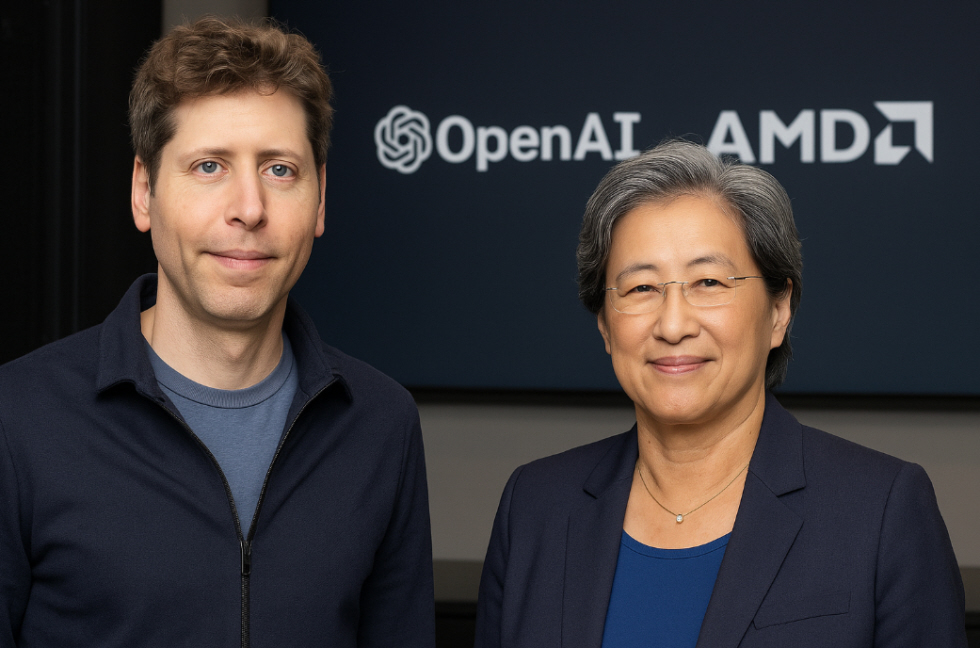
OpenAI has announced a strategic partnership with semiconductor leader AMD to secure access to its high-performance AI processors and expand computing capacity for future large language models. The deal, revealed by OpenAI CEO Sam Altman and AMD’s Lisa Su, marks a milestone in the race for AI hardware dominance. Under the agreement,
OpenAI will gain priority access to AMD’s new Instinct MI450 chips—designed for deep-learning workloads and generative AI training—while AMD receives an option to acquire up to ten percent equity in OpenAI, depending on milestone achievements tied to computing infrastructure. The alliance could reshape the global AI hardware market, which is currently dominated by NVIDIA. As competition for computing power intensifies, both companies aim to reduce dependence on a single supplier and promote a more diversified ecosystem. For OpenAI, this move represents a step toward greater hardware independence and sustainability as it prepares for GPT-6 and future models that will demand exponentially more computing resources.
AMD’s Instinct MI450 chip, based on its new Zen 6 architecture, achieves up to 30 percent higher efficiency per watt than its predecessor and halves inference latency. OpenAI engineers worked closely with AMD to optimize the chip for large-scale model training, allowing faster performance at lower cost compared to cloud GPU rentals. The collaboration also includes a joint research center in Austin, Texas, dedicated to developing next-generation AI accelerators and software frameworks.
The facility will integrate AMD’s hardware expertise with OpenAI’s experience in large-scale AI systems, employing more than 300 specialists when it opens in mid-2026. Lisa Su described the partnership as “a turning point in AI computing,” highlighting AMD’s commitment to democratizing access to high-performance technology. She confirmed that the new chips will use TSMC’s 3-nanometer process, enhancing energy efficiency and scalability for enterprise-level AI infrastructure.
For OpenAI, the deal strengthens its autonomy amid growing competition from Google DeepMind, Anthropic, and xAI—all pursuing proprietary chip strategies. The company plans to work with at least three hardware partners by 2026 to ensure continuous supply and resilience against global chip shortages. Financial markets reacted positively, with AMD shares climbing more than six percent after the announcement. Analysts say the deal boosts OpenAI’s long-term value by securing a steady computing pipeline, addressing one of the industry’s most pressing bottlenecks.
Sam Altman called the collaboration “a commitment to open, sustainable intelligence,” emphasizing that AI’s future depends on innovation at both the software and hardware levels. “To build the future of intelligence, we must first build the machines that make it possible,” he said. The OpenAI-AMD alliance signals more than a business deal—it marks a new era where silicon and intelligence evolve together, shaping the next generation of artificial intelligence.